Travel expenses
This page is a general guide for business travel: what to do before you go, how to pick a hotel and how to get to the customer site, and how to track expenses and get them compensated.
Hotel booking
When you choose a hotel, look for something as close to the customer location as you can, so you can walk there comfortably or reach it easily by public transport. It is also good to keep an eye on the price and pick something reasonable.
We usually book on booking.com. Use the map on the site to see what is nearby. For the room, look for a maximum of 150€ per night including breakfast. That is a guideline, not a fixed cap. In a tourist area or during a busy week it can happen that a room costs more than that. Apart from location and price, pick what you like and what you need. If you travel with colleagues, talk to them first so everyone is fine with the hotel.
If you are happy with your pick, check that enough rooms are free for everyone in your group. Then send the booking.com link and the details (dates, room type, number of guests) to one of the founders. They will place the booking for you.
Getting there
How you travel depends on where the pentest is and what is practical for the trip.
Public transport
If the site is in a place we can reach well by train, we prefer going by train via ÖBB for economy and sustainability reasons. For example, if the business location is in Salzburg city, it is well reachable and going by train makes more sense than by car.
Make sure your ÖBB account is in the Syslifters ÖBB Business Unit before you buy tickets. If it is not set up yet, ask Christoph to add you. In the business unit you book tickets on invoice (the invoice goes directly to Syslifters once a month, so you do not pay anything yourself up front), and tickets come with a 20% discount.
Workflow for train tickets:
- Get written confirmation from the customer that the pentest is approved and will be onsite.
- Plan the journey in the ÖBB ticket shop. Check date, time, stations, and names carefully before you pay.
- Book the ticket. If you can, book for colleagues on the same order so they do not all repeat the same steps.
Someone on the trip may use a private Klimaticket instead of a company ticket. That is allowed, and we pay the ticket holder back using a fictive ticket (see below under Klimaticket compensation).
If you use other public transport on the trip (tram, bus, metro), keep every receipt. We cannot reimburse a ticket without one.
For trips of around three hours or longer, especially if you want to work on the train, 1st class is often worth it. You can decide case by case.
Working on the train means you should watch for shoulder surfing, use a privacy screen or angle your display, lock your laptop when you leave your seat, and never leave equipment unattended.
Car
Sometimes public transport is not realistic, or you would spend too much time commuting each day. Then travelling by car is fine.
Still try to carpool. It is cheaper and better for the environment if not everyone drives alone.
Any car trip where you claim Kilometergeld must be logged in the Fahrtenbuch part of the Reisekostenrechner. Use the shortest reasonable route. If you detour, write down where you went and why (for example a crash on the A1 or a closed road). Note which parts of the drive had colleagues in the car.
Expenses and compensation
Receipts
For anything you pay yourself (train tickets, seat reservations, parking, local transport, and similar), you need a receipt. Without it we cannot pay you back. Scan receipts and store them digitally, then hand them in to one of the founders together with the rest of your travel expense documents (e.g. the Reisekostenrechner).
Reisekostenrechner
The Reisekostenrechner.xlsx is the spreadsheet we use to calculate what gets paid out for a business trip. It uses the Austrian §26 EStG rates and works out the Taggeld and Kilometergeld for you, so you only have to fill in the actual trip data.
The file has three kinds of sheets:
- "Meta" lists the current rates (Kilometergeld, Mitfahrer-Zuschlag, Taggeld Inland, Kürzung bei bezahltem Essen). You normally do not change anything here.
- "Reise 1" to "Reise 5" is one sheet per business trip. You fill in:
- Whether the trip meets the Taggeld conditions (more than 25 km from the place of work, more than 3 hours away, number of meals provided by the customer).
- The trip details (employee, project or cost centre, customer site, start and end date and time).
- The Fahrtenbuch if you went by car (date, departure and arrival time, odometer start and end, passengers).
- "Gesamt" sums up all trips and shows the total payout.
Fill in only the input fields on the left of the trip sheets. The Berechnungen column on the right and the Gesamt sheet are calculated automatically. Go through everything once more before you send it to the founders. If a field is unclear, ask.
Klimaticket compensation
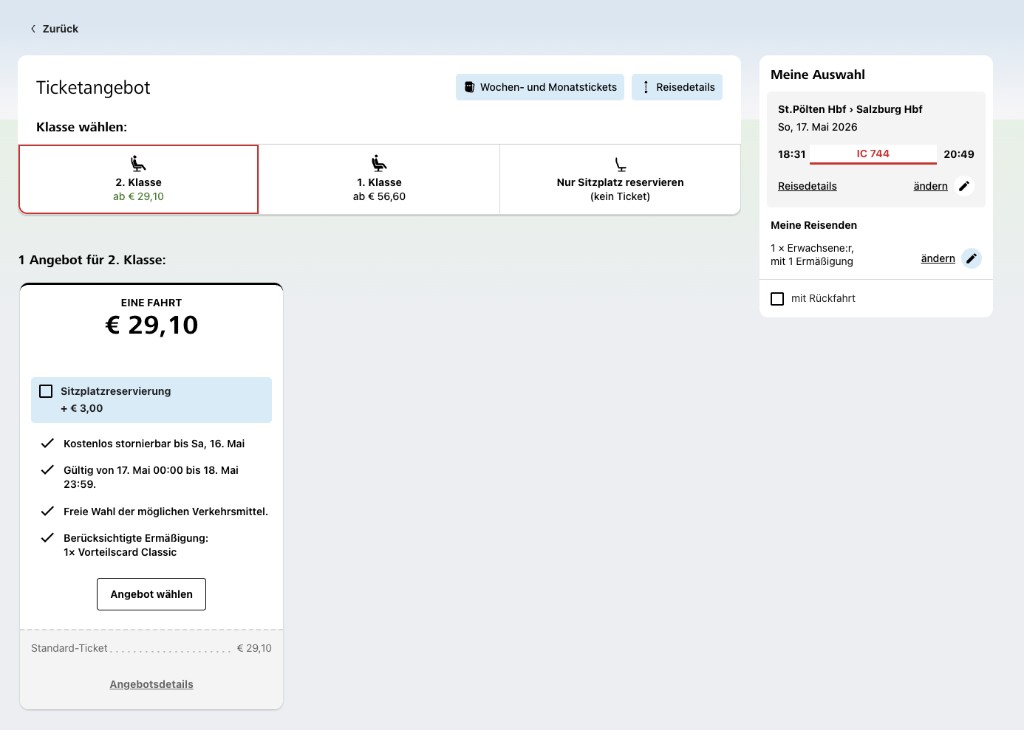
If you took the train on your private Klimaticket, you did not buy a ticket for the trip, but we can still reimburse you. We use a fictive ticket: the price you would have paid with a Vorteilscard Classic on the train you actually used.
Steps:
- Open the ÖBB ticket planner.
- Enter the same route, date, and time as your real trip.
- Select the train you travelled on.
- Choose the Vorteilscard Classic discount.
- Screenshot the order page that shows the price (you do not need to buy).
- Add the screenshot when you submit your Reisekostenrechner.
Example screenshot: